




How does a cylinder differ from a cone?
Nov 07, 2025
Leave a message
Hey there! As a cylinder supplier, I've been dealing with these mechanical wonders for ages. And one question I get asked a lot is, "How does a cylinder differ from a cone?" Well, let's dive right in and break it down.
Shape and Structure
First off, the most obvious difference is in their shapes. A cylinder is like a tube with two parallel circular bases that are the same size. It's got straight sides that run parallel to each other from one base to the other. You can think of a soda can or a pipe as a real - world example of a cylinder.
On the other hand, a cone has a circular base at one end, and then it tapers smoothly to a single point called the apex or vertex at the other end. An ice - cream cone is a classic example that we're all familiar with. This shape difference has a huge impact on how they're used in various applications.
Volume and Capacity
When it comes to volume, the formulas for calculating the volume of a cylinder and a cone are quite different. The volume of a cylinder is given by the formula (V = \pi r^{2}h), where (r) is the radius of the base and (h) is the height of the cylinder. This means that if you know the radius of the circular base and the height of the cylinder, you can easily figure out how much space it can hold.
For a cone, the volume formula is (V=\frac{1}{3}\pi r^{2}h). Notice that it's one - third of the volume of a cylinder with the same base radius (r) and height (h). This difference in volume calculation is crucial in industries where storage or displacement of fluids or materials is important. For instance, in hydraulic systems, cylinders are often used when you need a larger volume of fluid displacement, while cones might be used in applications where less volume is required in a tapered space.


Surface Area
The surface area of a cylinder consists of two circular bases and the lateral surface area. The formula for the total surface area of a cylinder (A = 2\pi r^{2}+2\pi rh), where the first part (2\pi r^{2}) accounts for the two circular bases and (2\pi rh) is the lateral surface area.
A cone's surface area is a bit more complicated. It includes the area of the circular base (\pi r^{2}) and the lateral surface area (\pi rl), where (l) is the slant height of the cone. The slant height is the distance from the apex to a point on the circumference of the base. The difference in surface area means that cylinders and cones interact differently with their surroundings. For example, in heat transfer applications, a cylinder's larger and more uniform surface area might allow for more efficient heat exchange compared to a cone.
Applications
Cylinders
Cylinders have a wide range of applications. In the automotive industry, they're used in engines as part of the piston - cylinder system. The reciprocating motion of the piston inside the cylinder converts the energy from the combustion of fuel into mechanical energy, which powers the vehicle.
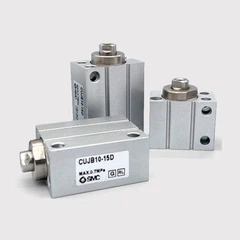
In the manufacturing and construction sectors, hydraulic and pneumatic cylinders are used to provide linear motion. These cylinders can lift heavy loads, move machinery parts, and perform various other tasks with precision. For example, our MGPM20 - 125Z Cylinder is a popular choice in many industrial applications. It offers reliable performance and can handle a certain amount of pressure to get the job done.
Another great option is our MGPM12 - 100Z Cylinder. It's smaller in size but still packs a punch when it comes to providing the necessary linear motion in more compact spaces. And for heavy - duty applications, the CD85N25 - 175 - B Cylinder is a top - notch choice. It can withstand high pressures and is built to last in tough working environments.
Cones
Cones are also used in many different fields. In loudspeakers, cones are used to convert electrical signals into sound waves. The cone vibrates in response to the electrical current, creating the sound that we hear.
In the field of optics, cones are used in some types of lenses and light - focusing devices. The tapered shape of the cone helps in directing and concentrating light in a specific way.
Stability
Cylinders are generally more stable than cones. Due to their parallel sides and two - base structure, they can stand upright on a flat surface without much effort. They can also support loads more evenly across their base. This makes them ideal for applications where stability is a key factor, such as in building structures or heavy - machinery supports.
Cones, on the other hand, are less stable when standing on their base. They have a tendency to tip over more easily, especially if they're tall or if there's an external force acting on them. However, this instability can be an advantage in some applications. For example, in traffic cones, the fact that they can be easily knocked over and then right themselves helps prevent damage to vehicles in case of an accidental collision.
Manufacturing and Production
Manufacturing cylinders and cones also involves different processes. Cylinders can be made through various methods such as extrusion, where a material is forced through a die to create the cylindrical shape. They can also be machined from solid blocks of material, especially when high precision is required.
Cones are often formed through processes like casting or forging. In casting, molten material is poured into a cone - shaped mold and allowed to cool and solidify. Forging involves shaping the material by applying pressure, which can be useful for creating cones with high strength.
Conclusion
So, as you can see, cylinders and cones are two very different geometric shapes with their own unique characteristics, advantages, and applications. Whether you're in the automotive, manufacturing, or any other industry, understanding these differences is crucial for making the right choice for your specific needs.
If you're in the market for high - quality cylinders, we've got you covered. Our range of cylinders, like the MGPM20 - 125Z Cylinder, MGPM12 - 100Z Cylinder, and CD85N25 - 175 - B Cylinder, are designed to meet the highest standards of performance and reliability. If you're interested in learning more or discussing your specific requirements, don't hesitate to reach out. We're here to help you find the perfect cylinder for your project.
References
- "Engineering Mechanics: Statics and Dynamics" by R.C. Hibbeler
- "Fluid Mechanics" by Frank M. White
- "Materials Science and Engineering: An Introduction" by William D. Callister Jr. and David G. Rethwisch
Send Inquiry