




How to calculate the pressure drop in a cylindrical pipe?
Dec 30, 2025
Leave a message
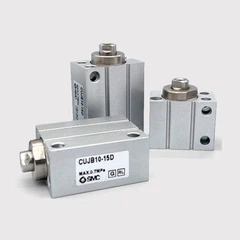
Hey there! As a cylinder supplier, I often get asked about how to calculate the pressure drop in a cylindrical pipe. It's a crucial topic, especially for those who use our CD85N25-200C-B Cylinder, MGPM12-100Z Cylinder, or CD85N25-175-B Cylinder in their systems. So, let's dive right in and break down the process.
Understanding Pressure Drop
First things first, what exactly is pressure drop? Well, when fluid (that can be a gas or a liquid) flows through a pipe, it loses some of its energy due to friction between the fluid and the pipe walls, as well as other factors like changes in the pipe's diameter or bends. This loss of energy results in a decrease in pressure along the pipe, and that's what we call pressure drop.
Why does it matter? Pressure drop can have a significant impact on the performance of your system. If the pressure drop is too high, it can lead to reduced flow rates, inefficient operation, and even damage to your equipment. So, being able to calculate it accurately is essential for designing and maintaining a reliable system.
Factors Affecting Pressure Drop
Before we get into the calculations, let's take a look at the factors that influence pressure drop in a cylindrical pipe:
- Pipe Diameter: A smaller pipe diameter generally means higher pressure drop because the fluid has less space to flow through, resulting in more friction.
- Pipe Length: The longer the pipe, the more friction the fluid encounters, and thus the higher the pressure drop.
- Fluid Velocity: Faster-moving fluids experience more friction, leading to increased pressure drop.
- Fluid Viscosity: Viscous fluids are thicker and stickier, causing more resistance to flow and higher pressure drop.
- Pipe Roughness: A rough pipe interior creates more turbulence and friction, resulting in higher pressure drop compared to a smooth pipe.
Calculating Pressure Drop
Now, let's get to the nitty-gritty of the calculations. There are several methods to calculate pressure drop, but one of the most commonly used is the Darcy-Weisbach equation.
Darcy-Weisbach Equation
The Darcy-Weisbach equation is given by:
[ \Delta P = f \frac{L}{D} \frac{\rho V^2}{2} ]


Where:
- (\Delta P) is the pressure drop (in Pa)
- (f) is the Darcy friction factor
- (L) is the length of the pipe (in m)
- (D) is the internal diameter of the pipe (in m)
- (\rho) is the density of the fluid (in kg/m³)
- (V) is the average velocity of the fluid (in m/s)
Finding the Darcy Friction Factor
The Darcy friction factor ((f)) depends on the flow regime (laminar or turbulent) and the relative roughness of the pipe.
- Laminar Flow: For laminar flow (Reynolds number (Re < 2000)), the Darcy friction factor can be calculated using the following formula:
[ f = \frac{64}{Re} ]
Where (Re) is the Reynolds number, given by:
[ Re = \frac{\rho V D}{\mu} ]
Here, (\mu) is the dynamic viscosity of the fluid (in Pa·s).
- Turbulent Flow: For turbulent flow ((Re > 4000)), the Darcy friction factor can be determined using the Colebrook equation:
[ \frac{1}{\sqrt{f}} = -2.0 \log \left( \frac{\epsilon/D}{3.7} + \frac{2.51}{Re \sqrt{f}} \right) ]
Where (\epsilon) is the roughness height of the pipe (in m). Solving the Colebrook equation for (f) usually requires an iterative method, but there are also some approximate equations that can be used for a quicker estimate.
Step-by-Step Calculation
Let's go through an example to see how to use the Darcy-Weisbach equation to calculate pressure drop:
- Gather the Data: You'll need to know the pipe diameter ((D)), pipe length ((L)), fluid density ((\rho)), fluid velocity ((V)), fluid viscosity ((\mu)), and pipe roughness ((\epsilon)).
- Calculate the Reynolds Number: Use the formula (Re = \frac{\rho V D}{\mu}) to determine the flow regime.
- Find the Darcy Friction Factor: If the flow is laminar ((Re < 2000)), use (f = \frac{64}{Re}). If it's turbulent ((Re > 4000)), you can use an iterative method to solve the Colebrook equation or an approximate equation.
- Calculate the Pressure Drop: Plug the values of (f), (L), (D), (\rho), and (V) into the Darcy-Weisbach equation (\Delta P = f \frac{L}{D} \frac{\rho V^2}{2}) to find the pressure drop.
Example Calculation
Let's say we have a cylindrical pipe with an internal diameter of 0.1 m and a length of 10 m. The fluid flowing through the pipe is water with a density of 1000 kg/m³ and a viscosity of 0.001 Pa·s. The average velocity of the water is 2 m/s, and the pipe has a roughness height of 0.0001 m.
-
Calculate the Reynolds Number:
[ Re = \frac{\rho V D}{\mu} = \frac{1000 \times 2 \times 0.1}{0.001} = 200000 ]
Since (Re > 4000), the flow is turbulent. -
Find the Darcy Friction Factor:
We'll use an approximate equation to find (f). For a smooth pipe ((\epsilon/D = 0.0001/0.1 = 0.001)), we can use the Blasius equation:
[ f = 0.3164 Re^{-0.25} = 0.3164 \times 200000^{-0.25} \approx 0.018 ] -
Calculate the Pressure Drop:
[ \Delta P = f \frac{L}{D} \frac{\rho V^2}{2} = 0.018 \times \frac{10}{0.1} \times \frac{1000 \times 2^2}{2} = 3600 \text{ Pa} ]
So, the pressure drop in this pipe is 3600 Pa.
Other Considerations
- Pipe Fittings and Valves: In addition to the straight pipe, you also need to consider the pressure drop caused by pipe fittings (like elbows, tees, and reducers) and valves. These components can add significant resistance to the flow and increase the overall pressure drop. You can use equivalent length methods to account for the additional pressure drop caused by fittings and valves.
- Non-Newtonian Fluids: The Darcy-Weisbach equation is based on the assumption that the fluid is Newtonian (its viscosity remains constant regardless of the shear rate). If you're dealing with non-Newtonian fluids, like some polymers or slurries, you'll need to use more complex models to calculate the pressure drop.
Conclusion
Calculating pressure drop in a cylindrical pipe might seem daunting at first, but by understanding the factors involved and using the right equations, you can do it with confidence. Remember, accurate pressure drop calculations are crucial for designing and maintaining an efficient and reliable system.
If you're in the market for high-quality cylinders for your system, look no further. Our CD85N25-200C-B Cylinder, MGPM12-100Z Cylinder, and CD85N25-175-B Cylinder are designed to provide reliable performance and help you achieve optimal system operation.
If you have any questions about pressure drop calculations or need assistance in selecting the right cylinder for your application, don't hesitate to reach out. We're here to help you make the best choices for your system.
References
- Munson, B. R., Young, D. F., & Okiishi, T. H. (2013). Fundamentals of Fluid Mechanics. John Wiley & Sons.
- Streeter, V. L., & Wylie, E. B. (1981). Fluid Mechanics. McGraw-Hill.
Send Inquiry