




How to find the volume of a cylinder when only the circumference and height are known?
Oct 28, 2025
Leave a message
Hey there! I'm a supplier of cylinders, and I often get asked how to find the volume of a cylinder when you only know the circumference and height. It's a common question, especially for those who are working on projects or need to calculate things like how much fluid a cylinder can hold. So, I thought I'd share a step-by-step guide on how to do it.
First off, let's quickly go over what a cylinder is. A cylinder is a three-dimensional shape with two circular bases that are parallel to each other, and a curved surface connecting these bases. The volume of a cylinder tells you how much space it occupies, and it's super useful to know in many industries, like manufacturing, engineering, and even in some DIY projects.
Now, let's say you've got a cylinder, and all you know about it is the circumference of its base and its height. How do you find the volume? Well, here's the game plan.
Step 1: Find the Radius from the Circumference
The formula for the circumference of a circle is (C = 2\pi r), where (C) is the circumference, (\pi) is a mathematical constant (approximately 3.14159), and (r) is the radius of the circle. Since we know the circumference (C), we can solve this formula for (r).
To do that, we rearrange the formula to get (r=\frac{C}{2\pi}). For example, if the circumference of the base of our cylinder is 18.84 units, we can find the radius like this:


[r=\frac{18.84}{2\times3.14159}\approx\frac{18.84}{6.28318}\approx 3]
So, the radius of the base of the cylinder is approximately 3 units.
Step 2: Calculate the Area of the Base
Once we have the radius, we can find the area of the circular base of the cylinder. The formula for the area of a circle is (A=\pi r^{2}). Using the radius we just found (in our example, (r = 3) units), we can calculate the area as follows:
[A=\pi\times(3)^{2}= 9\pi\approx9\times3.14159 = 28.27431]
So, the area of the base of the cylinder is approximately 28.27 square units.
Step 3: Determine the Volume of the Cylinder
Now that we know the area of the base (A) and the height (h) of the cylinder, we can find the volume (V). The formula for the volume of a cylinder is (V = A\times h), which means we just multiply the area of the base by the height.
Let's say the height of our cylinder is 5 units. Then the volume is:
[V=28.27431\times5 = 141.37155]
So, the volume of the cylinder is approximately 141.37 cubic units.
Real - World Applications
Knowing how to calculate the volume of a cylinder can be really handy in a lot of real - world situations. For instance, if you're in the business of storing liquids or gases in cylinders, you need to know how much they can hold. Or, if you're designing a cylinder for a specific purpose, like a hydraulic cylinder in a machine, you'll need to calculate its volume to ensure it meets the requirements.
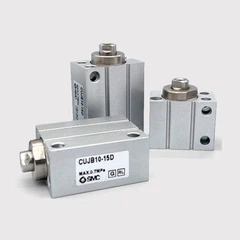
As a cylinder supplier, I deal with all sorts of cylinders, each with its own unique specifications. Take a look at some of the cylinders we offer:
- CD85N25 - 200C - B Cylinder: This cylinder is designed for specific industrial applications and has its own set of dimensions.
- MGPM12 - 100Z Cylinder: It's another great option, suitable for different tasks where precise fluid control is needed.
- CD85N25 - 175 - B Cylinder: This one also has its own characteristics and can be used in various setups.
Why It Matters for Us Suppliers
As a cylinder supplier, understanding how to calculate the volume of a cylinder is crucial. It helps us communicate better with our customers. When a customer asks about the capacity of a cylinder, we can quickly calculate it based on the available information. It also allows us to ensure that the cylinders we supply meet the required volume specifications for different applications.
Conclusion and Call to Action
So, there you have it! A simple way to find the volume of a cylinder when you only know the circumference and height. Whether you're a DIY enthusiast, an engineer, or someone in the manufacturing industry, this knowledge can come in really handy.
If you're in the market for high - quality cylinders, we've got you covered. We offer a wide range of cylinders to meet your specific needs. Whether you need a small cylinder for a delicate project or a large one for heavy - duty applications, we can help. Don't hesitate to reach out to us for more information or to start a procurement discussion. We're here to make sure you get the right cylinder for your job.
References
- Math textbooks on geometry and solid figures.
- Online resources on basic mathematical formulas and applications.
Send Inquiry