




What is a lidar sensor?
Dec 26, 2025
Leave a message
What is a lidar sensor? Well, let me break it down for you in plain English. As a sensor supplier, I've dealt with all sorts of sensors, and lidar is one of the most fascinating ones out there.
Lidar stands for Light Detection and Ranging. It's a remote - sensing technology that uses light in the form of a pulsed laser to measure distances. Think of it like a super - accurate version of sonar, but instead of sound waves, it uses light.
Here's how it works. A lidar sensor emits a laser beam. When this beam hits an object, it bounces back to the sensor. The sensor then measures the time it takes for the light to travel to the object and back. Using the speed of light (which is a constant), it can calculate the distance between the sensor and the object.
Let's say you're in a self - driving car. The lidar sensor on the car is constantly sending out laser pulses in all directions. It creates a 3D map of the car's surroundings in real - time. This map helps the car "see" obstacles, other vehicles, pedestrians, and traffic signs. It's like giving the car a pair of super - sharp eyes.
But lidar isn't just for self - driving cars. It has a wide range of applications. In the field of archaeology, lidar can be used to map ancient ruins hidden under dense vegetation. The laser can penetrate through the leaves and create a detailed map of the terrain below, revealing structures that might otherwise be hard to spot.
In forestry, lidar sensors can measure the height and density of trees. This information is crucial for forest management, such as estimating the amount of timber available, monitoring forest health, and planning logging operations.


In the construction industry, lidar can be used to create accurate 3D models of building sites. Architects and engineers can use these models to plan and design buildings more effectively. It can also be used to monitor the progress of construction projects and ensure that everything is being built according to the plans.
Now, let's talk about the different types of lidar sensors. There are mechanical lidar sensors, which have moving parts. These sensors rotate to send out laser pulses in different directions. They can provide a full 360 - degree view, but they tend to be more expensive and less reliable due to the moving parts.
On the other hand, there are solid - state lidar sensors. These sensors don't have any moving parts. They use electronic components to steer the laser beam. Solid - state lidar sensors are generally smaller, more durable, and cheaper. They're becoming more popular, especially in consumer applications.
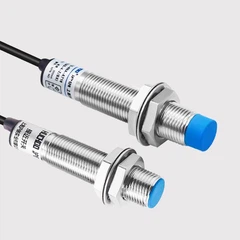
As a sensor supplier, I've seen the demand for lidar sensors grow significantly in recent years. That's why I offer a variety of high - quality lidar sensors, along with other types of sensors like the E2B - M12KN08 - WZ - B1 Sensor, the E3JK - RR11 - C 2M OMS Sensor, and the IE5338 Sensor.
When choosing a lidar sensor, there are several factors to consider. One of the most important factors is the range. The range of a lidar sensor determines how far it can "see". If you're using it for a self - driving car, you'll need a sensor with a long range to detect obstacles from a distance.
Another factor is the resolution. The resolution of a lidar sensor refers to how detailed the 3D map it creates is. A higher - resolution sensor will provide a more detailed map, but it may also be more expensive.
The field of view is also important. A wider field of view means the sensor can cover a larger area. This is crucial in applications where you need to monitor a large space, like in a warehouse or a large outdoor area.
Cost is, of course, a major consideration. Lidar sensors can vary widely in price, depending on their features and performance. You need to find a sensor that fits your budget while still meeting your requirements.
If you're in the market for a lidar sensor or any of the other sensors I mentioned, I'm here to help. I have a team of experts who can assist you in choosing the right sensor for your specific application. Whether you're a small business owner, a researcher, or part of a large corporation, we can provide you with the best solutions.
Don't hesitate to reach out if you have any questions or if you're interested in purchasing sensors. We can have a detailed discussion about your needs and find the perfect sensor for you.
In conclusion, lidar sensors are an amazing technology with a wide range of applications. They're changing the way we interact with the world around us, from making our roads safer with self - driving cars to helping us discover hidden archaeological treasures. As a sensor supplier, I'm excited to be part of this technological revolution and to help you find the right sensors for your projects.
References
- "Lidar Remote Sensing: Principles and Applications" by George V. Guenther
- "Introduction to Lidar: Remote Sensing and Science" by John B. DeWitt and Michael S. Powell
Send Inquiry