




What is the effect of changing the radius on the surface area of a cylinder?
Sep 15, 2025
Leave a message
Hey there! As a cylinder supplier, I've been dealing with all sorts of cylinders on a daily basis. One question that often pops up is, "What is the effect of changing the radius on the surface area of a cylinder?" Well, let's dive right in and figure this out together.
First off, let's quickly go over what a cylinder is and how we calculate its surface area. A cylinder is a three - dimensional shape with two circular bases and a curved surface connecting them. The formula for the surface area of a cylinder, (SA), is (SA = 2\pi r^{2}+2\pi rh), where (r) is the radius of the base of the cylinder and (h) is the height of the cylinder. The (2\pi r^{2}) part comes from the two circular bases (since the area of a single circle is (\pi r^{2})), and the (2\pi rh) part represents the area of the curved surface.
Now, let's see what happens when we change the radius. Suppose we have a cylinder with an initial radius (r_1) and height (h). Its surface area (SA_1=2\pi r_1^{2}+2\pi r_1h). If we increase the radius to (r_2) ((r_2 > r_1)), the new surface area (SA_2 = 2\pi r_2^{2}+2\pi r_2h).
Let's break down the changes in each part of the surface - area formula.
Effect on the area of the bases
The area of the two bases with radius (r_1) is (A_{b1}=2\pi r_1^{2}), and with radius (r_2) is (A_{b2}=2\pi r_2^{2}). The difference (\Delta A_b=2\pi r_2^{2}-2\pi r_1^{2}=2\pi(r_2^{2}-r_1^{2})). Since (r_2^{2}-r_1^{2}=(r_2 + r_1)(r_2 - r_1)), when we increase the radius, the area of the bases increases non - linearly. For example, if (r_1 = 1) and (r_2 = 2), then (A_{b1}=2\pi(1)^{2}=2\pi) and (A_{b2}=2\pi(2)^{2}=8\pi). The increase in the area of the bases is (8\pi - 2\pi = 6\pi).
Effect on the area of the curved surface
The area of the curved surface with radius (r_1) is (A_{c1}=2\pi r_1h), and with radius (r_2) is (A_{c2}=2\pi r_2h). The difference (\Delta A_c=2\pi r_2h-2\pi r_1h = 2\pi h(r_2 - r_1)). Here, the change in the area of the curved surface is directly proportional to the change in the radius. If the height (h) is constant, as the radius increases, the area of the curved surface also increases.
Overall, when we increase the radius of a cylinder, the surface area increases. And this increase can be quite significant, especially when the radius change is large.
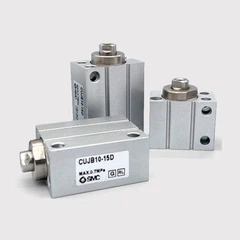
Let's take a look at some real - world examples of cylinders. We have some great products like the CD85N25 - 175 - B Cylinder and the CD85N25 - 200C - B Cylinder. These cylinders are used in various industrial applications, and the surface - area characteristics play an important role. A larger - radius cylinder might have a greater surface area, which could affect heat dissipation if it's used in a system where heat needs to be transferred.
Another example is the MGPM12 - 100Z Cylinder. In some cases, a larger surface area due to a bigger radius can provide more space for mounting sensors or other accessories.
So, why does this matter for you as a customer? Well, depending on your application, you might need a cylinder with a specific surface area. If you're dealing with a heat - transfer problem, a cylinder with a larger radius and thus a larger surface area could be beneficial. On the other hand, if space is a constraint, you might want to go for a cylinder with a smaller radius.


As a cylinder supplier, I can help you choose the right cylinder for your needs. Whether you need a cylinder with a specific radius to achieve a certain surface area or other requirements, I've got you covered. If you're interested in any of our products or have questions about how the radius affects the surface area in your particular application, don't hesitate to reach out. We can have a detailed discussion and figure out the best solution for you.
In conclusion, changing the radius of a cylinder has a significant impact on its surface area. The area of the bases changes non - linearly, while the area of the curved surface changes linearly with the change in radius. Understanding this relationship can help you make more informed decisions when it comes to choosing the right cylinder for your projects.
If you're in the market for a cylinder and want to discuss your requirements, feel free to start a conversation. We're here to assist you in finding the perfect cylinder that meets all your needs.
References
- Basic Geometry textbooks for the surface - area formula of a cylinder.
- Industry - specific literature on the applications of cylinders.
Send Inquiry