




What is the flow rate through a cylindrical pipe?
Sep 24, 2025
Leave a message
Hey there! As a cylinder supplier, I often get asked about the flow rate through a cylindrical pipe. It's a pretty common question, especially for those in industries that rely on fluid or gas transfer. So, let's dive right in and break down what flow rate is and how it relates to cylindrical pipes.
First off, what exactly is flow rate? Well, in simple terms, flow rate is the volume of fluid or gas that passes through a given point in a pipe per unit of time. It's usually measured in units like cubic meters per second (m³/s), liters per minute (L/min), or cubic feet per second (ft³/s). Understanding flow rate is crucial because it helps us determine how much fluid or gas can be transported through a pipe, which is essential for designing efficient systems.
Now, let's talk about cylindrical pipes. These are the most common type of pipes used in various applications, from plumbing to industrial processes. The flow rate through a cylindrical pipe depends on several factors, including the pipe's diameter, length, the viscosity of the fluid or gas, and the pressure difference across the pipe.
One of the key factors affecting flow rate is the pipe's diameter. A larger diameter pipe generally allows for a higher flow rate because there's more space for the fluid or gas to move through. Think of it like a highway - a wider highway can accommodate more cars at once, just like a larger pipe can handle more fluid or gas. On the other hand, a smaller diameter pipe restricts the flow, reducing the flow rate.
The length of the pipe also plays a role. Longer pipes create more resistance to the flow, which can decrease the flow rate. It's like trying to push water through a long, narrow hose - the longer the hose, the harder it is to get the water to flow quickly.
The viscosity of the fluid or gas is another important factor. Viscosity refers to the thickness or stickiness of the substance. Fluids with high viscosity, like honey, flow more slowly than fluids with low viscosity, like water. So, if you're dealing with a highly viscous fluid, you'll likely have a lower flow rate through the pipe.
Finally, the pressure difference across the pipe is a major determinant of flow rate. A higher pressure difference creates a greater force to push the fluid or gas through the pipe, resulting in a higher flow rate. This is similar to how a stronger wind can push more air through a tunnel.
To calculate the flow rate through a cylindrical pipe, we can use some handy equations. One of the most commonly used equations is the Hagen - Poiseuille equation, which is applicable for laminar flow (smooth, orderly flow) of a viscous fluid through a cylindrical pipe. The equation is:
Q = (π * ΔP * r⁴) / (8 * η * L)
Where:
- Q is the flow rate
- ΔP is the pressure difference across the pipe
- r is the radius of the pipe
- η is the dynamic viscosity of the fluid
- L is the length of the pipe
However, this equation only works for laminar flow. In real - world scenarios, we often encounter turbulent flow (chaotic, irregular flow), especially at high flow rates or in pipes with rough interiors. For turbulent flow, we can use the Darcy - Weisbach equation, which is a more general equation that accounts for both laminar and turbulent flow:
h_f = f * (L / D) * (V² / 2g)


Where:
- h_f is the head loss due to friction
- f is the Darcy friction factor
- L is the length of the pipe
- D is the diameter of the pipe
- V is the average velocity of the fluid
- g is the acceleration due to gravity
The flow rate Q can then be calculated using the equation Q = A * V, where A is the cross - sectional area of the pipe (A = π * r²).
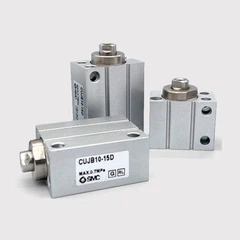
Now, let's talk about how this all relates to the cylinders we supply. At our company, we offer a wide range of cylinders, including the CD85N25 - 200C - B Cylinder, CD85N25 - 175 - B Cylinder, and MGPM12 - 100Z Cylinder. These cylinders are used in various applications where fluid or gas flow is involved, such as pneumatic systems.
In pneumatic systems, cylinders are used to convert the energy of compressed air into mechanical motion. The flow rate of the compressed air through the pipes connected to the cylinders is crucial for the proper operation of the system. If the flow rate is too low, the cylinders may not move quickly enough or may not be able to generate enough force. On the other hand, if the flow rate is too high, it can cause excessive wear and tear on the components and may even lead to system failures.
So, when selecting a cylinder for your application, it's important to consider the flow rate requirements. You need to ensure that the pipes and other components in the system can provide the necessary flow rate to operate the cylinder efficiently.
If you're unsure about the flow rate requirements for your specific application or which cylinder is the best fit, don't worry! Our team of experts is here to help. We have extensive experience in the industry and can provide you with the guidance and support you need to make the right choices.
Whether you're a small business looking for a simple pneumatic system or a large industrial company with complex requirements, we can offer customized solutions to meet your needs. We understand that every application is unique, and we're committed to providing high - quality products and excellent customer service.
So, if you're interested in learning more about our cylinders or need help with your flow rate calculations, feel free to reach out to us. We're always happy to have a chat and discuss how we can assist you in your project. Let's work together to ensure your system runs smoothly and efficiently.
References:
- "Fluid Mechanics" by Frank M. White
- "Introduction to Fluid Mechanics" by Robert W. Fox, Alan T. McDonald, and Philip J. Pritchard
Send Inquiry