



How to find the lateral surface area of a cylinder with a non - circular cross - section?
Oct 02, 2025
Leave a message
When dealing with cylinders in the industrial world, we usually encounter those with circular cross - sections. However, there are scenarios where cylinders come with non - circular cross - sections. As a cylinder supplier, I often get questions from clients about calculating the lateral surface area of such non - standard cylinders. In this blog post, I'll share some effective methods to find the lateral surface area of a cylinder with a non - circular cross - section.
Understanding the Basics
Before we delve into the calculations, it's crucial to understand what the lateral surface area represents. For any cylinder, the lateral surface area is the area of the curved surface that connects the two bases. In a cylinder with a circular cross - section, we use the well - known formula (A = 2\pi rh), where (r) is the radius of the base and (h) is the height of the cylinder. But when the cross - section is non - circular, we need to take a different approach.
Method 1: Using the Perimeter of the Cross - Section
The fundamental principle for finding the lateral surface area of a non - circular cylinder is similar to that of a circular one. The lateral surface area (A) of a cylinder can be calculated by multiplying the perimeter (P) of the non - circular cross - section by the height (h) of the cylinder. That is (A=P\times h).
Let's say we have a cylinder with a rectangular cross - section. If the length of the rectangle is (l) and the width is (w), the perimeter of the rectangular cross - section (P = 2(l + w)). Then, if the height of the cylinder is (h), the lateral surface area (A=2(l + w)h).
For example, if the length of the rectangular cross - section (l = 5) units, the width (w = 3) units, and the height of the cylinder (h = 10) units. First, we calculate the perimeter of the cross - section (P=2(5 + 3)=16) units. Then the lateral surface area (A = 16\times10=160) square units.
This method can be applied to any regular non - circular cross - section. For instance, if the cross - section is a regular hexagon with side length (s), the perimeter (P = 6s). And the lateral surface area (A=6sh), where (h) is the height of the cylinder.
Method 2: Integral Calculus for Irregular Cross - Sections
When dealing with cylinders having irregular non - circular cross - sections, integral calculus comes in handy. We can think of the lateral surface as being composed of infinitesimally thin strips.
Let's assume that the cross - section of the cylinder lies in the (xy) - plane and the axis of the cylinder is along the (z) - axis. We can parameterize the curve of the cross - section. Suppose the curve of the cross - section is given by a vector function (\vec{r}(t)=(x(t),y(t))) for (a\leq t\leq b), and the height of the cylinder is (h).
The arc length of the curve of the cross - section (s=\int_{a}^{b}\sqrt{(\frac{dx}{dt})^2+(\frac{dy}{dt})^2}dt). The lateral surface area (A = h\times\int_{a}^{b}\sqrt{(\frac{dx}{dt})^2+(\frac{dy}{dt})^2}dt)
For example, if the cross - section is an ellipse given by the parametric equations (x = a\cos t) and (y = b\sin t) for (0\leq t\leq2\pi), where (a) and (b) are the semi - major and semi - minor axes respectively.
We first find (\frac{dx}{dt}=-a\sin t) and (\frac{dy}{dt}=b\cos t). Then (\sqrt{(\frac{dx}{dt})^2+(\frac{dy}{dt})^2}=\sqrt{a^{2}\sin^{2}t + b^{2}\cos^{2}t})


The arc length of the ellipse (s=\int_{0}^{2\pi}\sqrt{a^{2}\sin^{2}t + b^{2}\cos^{2}t}dt). And if the height of the cylinder is (h), the lateral surface area (A=h\times\int_{0}^{2\pi}\sqrt{a^{2}\sin^{2}t + b^{2}\cos^{2}t}dt)
This integral is known as an elliptic integral and may not have a simple closed - form solution in most cases. However, numerical methods can be used to approximate its value.
Practical Applications in the Industry
As a cylinder supplier, I've seen various applications of non - circular cylinders. For example, in some custom - made machinery, non - circular cylinders are used to fit specific design requirements. Knowing how to calculate the lateral surface area is essential for tasks such as painting, coating, or wrapping the cylinders.
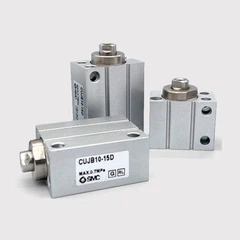
If you're interested in our high - quality cylinders, we offer a wide range of products, including the CD85N25 - 175 - B Cylinder, MGPM20 - 125Z Cylinder, and MGPM12 - 100Z Cylinder. These cylinders are made with precision and high - quality materials to meet your industrial needs.
Conclusion
Calculating the lateral surface area of a cylinder with a non - circular cross - section can be done using different methods depending on the nature of the cross - section. For regular non - circular cross - sections, the perimeter - height formula is straightforward and easy to apply. For irregular cross - sections, integral calculus provides a more accurate approach, although numerical approximations may be required.
If you have any questions about calculating the lateral surface area of non - circular cylinders or are interested in purchasing our cylinders, feel free to reach out for a procurement discussion. We're here to help you with all your cylinder - related needs.
References
- Stewart, James. "Calculus: Early Transcendentals." Cengage Learning, 2015.
- Hibbeler, R.C. "Engineering Mechanics: Statics and Dynamics." Pearson, 2016.
Send Inquiry